NATA 2027: Eligibility, Exam Pattern, Syllabus, Preparation & Coaching Guide
Architecture is a field that combines creativity, mathematics, visualisation, spatial understanding, design thinking and technical knowledge. For students who want to pursue a Bachelor of Architecture (B.Arch.) after Class 12, the National Aptitude Test in Architecture (NATA) is one of the most important entrance examinations to understand.
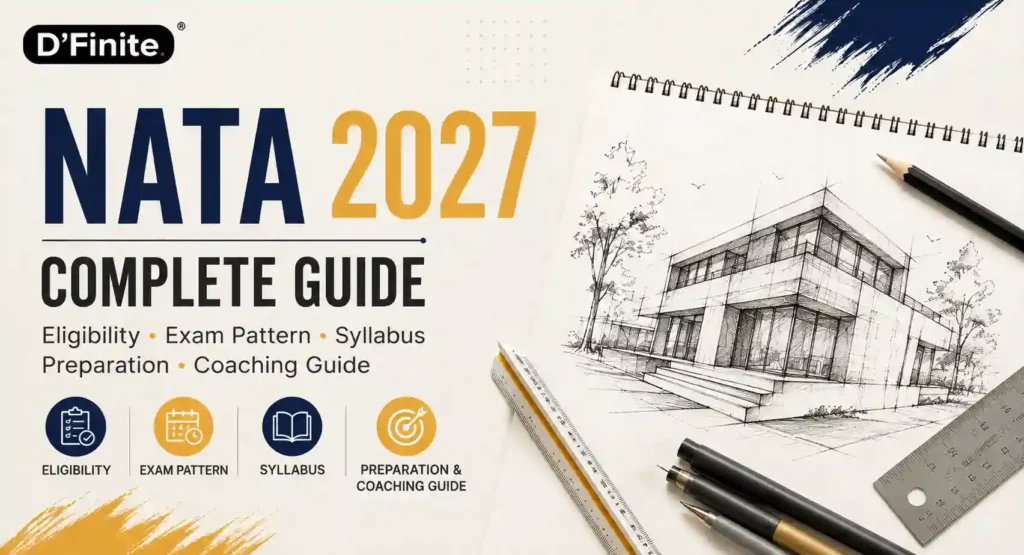
NATA (National Aptitude Test in Architecture) is a national-level architecture aptitude examination conducted by the Council of Architecture for admission to the first year of the five-year B.Arch. programme at recognised institutions. NATA assesses drawing and composition, visual reasoning, logical thinking, architecture and design awareness, design sensitivity, language interpretation and numerical ability.
NATA is conducted by the Council of Architecture (CoA) and serves as a national-level aptitude test for admission to the first year of the five-year B.Arch. degree course at recognised architectural institutions across India. The Council of Architecture introduced NATA in 2006 to provide a common aptitude test for architecture aspirants.
For students preparing for NATA 2027, it is important to understand that the examination is not simply a drawing test. NATA evaluates a combination of visual reasoning, logical thinking, architectural and design awareness, numerical ability, language interpretation, design sensitivity, drawing, composition and spatial understanding.
This complete guide covers NATA eligibility, exam pattern, syllabus, preparation strategy, important skills, career relevance and NATA coaching for aspiring architecture students.
What is NATA?
NATA stands for National Aptitude Test in Architecture.
It is a national-level aptitude examination conducted by the Council of Architecture (CoA) for admission to the first year of the five-year Bachelor of Architecture (B.Arch.) programme at recognised institutions.
According to the Council of Architecture, NATA assesses a candidate’s aptitude for architecture through areas such as cognitive skills, visual perception, aesthetic sensitivity, logical reasoning and critical thinking.
In simple terms, NATA attempts to understand whether a candidate has the visual, analytical and creative abilities required for studying architecture.

NATA Full Form
NATA – National Aptitude Test in Architecture
NATA Conducting Authority
Council of Architecture (CoA)
NATA Course
The examination is primarily associated with admission to the 5-year B.Arch. degree course at recognised architectural institutions.
Read Also
- UCEED 2027: Eligibility, Exam Pattern, Syllabus, Preparation Strategy, Colleges & Career Guide
- NID-DAT: Complete Guide to NID Entrance Exam
- NIFT Entrance Exam: Eligibility, Exam Pattern, Syllabus
- JEE Main Paper 2 (2027): B. Arch Exam Pattern, Syllabus, Eligibility
- CEED 2027: Eligibility, Exam Pattern, Syllabus, Preparation & Coaching Guide
Why is NATA Important for Architecture Aspirants?
Architecture requires a combination of artistic and analytical abilities. An architect must understand space, proportion, structure, materials, people, environment and the relationship between different elements.
NATA is designed to assess several of these underlying abilities.
The Council of Architecture describes NATA as a comprehensive aptitude test that measures a candidate’s suitability for the field of architecture through cognitive skills, visual perception, aesthetic sensitivity, logical reasoning and critical thinking.
Therefore, students preparing for NATA should not treat preparation as simply learning how to draw buildings.
A successful NATA preparation strategy should develop:
Visualisation + Drawing + Spatial Understanding + Logical Reasoning + Design Sensitivity + Mathematics + General Awareness
NATA Exam Pattern
The NATA examination pattern can change from one admission cycle to another, so students should always verify the latest official brochure before applying.
For NATA 2026, the examination was structured into two major parts:
Part A – Drawing and Composition
Part B – Computer-Based Test
The official NATA 2026 information specifies a total of 200 marks, with Part A carrying 80 marks and Part B carrying 120 marks.
NATA Part A – Drawing and Composition
Part A is an offline Drawing and Composition Test with a duration of 90 minutes.
It consists of three components:
| Component | Marks |
|---|---|
| Composition and Colour | 25 |
| Sketching & Composition – Black and White | 25 |
| 3D Composition | 30 |
| Total | 80 |
Composition and Colour
This section evaluates the candidate’s ability to create a visual composition using colour and communicate an idea effectively.
Students should understand basic principles of:
Sketching and Composition
This component evaluates the ability to draw, visualise and depict situations involving buildings, people, environments and products, while demonstrating an understanding of scale, proportion, texture, shade and shadow.
This is why architecture aspirants should practise observational sketching instead of only copying reference drawings.
3D Composition
The 3D composition component evaluates the ability to create an interesting three-dimensional composition for a given situation using the provided kit.
Students should therefore develop an understanding of:
Form + Volume + Balance + Spatial Relationships + Construction
NATA Part B – Online Aptitude Test
For NATA 2026, Part B was a 90-minute online adaptive test carrying 120 marks.
It consisted of:
- 42 MCQs
- 8 NCQs
- 50 questions in total
The official NATA brochure identifies the following major areas for Part B.
Visual Reasoning
Visual reasoning involves understanding and reconstructing 2D and 3D compositions, along with their technical and compositional relationships.
Students should practise:
Logical Derivation
This section tests the ability to decode a situation, composition or context and generate meaningful conclusions.
Students should develop structured reasoning rather than relying on guesswork.
General Knowledge, Architecture and Design
NATA preparation should include awareness of:
The official NATA syllabus specifically includes general awareness of architecture and design, important buildings, historical progression and innovations in materials and construction technology.
Language Interpretation
Language interpretation evaluates the ability to understand and logically interpret words and sentences, including aspects of English grammar.
Design Sensitivity and Thinking
Design sensitivity is an important component of NATA.
Students need to observe and analyse people, spaces, products and environments, identify subtle communication, understand concepts and approach problems critically.
This is an area where regular exposure to real-world environments can be extremely useful.
Numerical Ability
NATA mathematics is connected to the practical and creative understanding of space and geometry.
The official syllabus includes basic mathematics and its association with creative thinking, including the use of geometry to unfold space.
NATA Syllabus
The NATA syllabus is broader than traditional drawing and mathematics.
For effective preparation, students should cover the following major areas:
Drawing and Sketching
Students should practise:
Composition and Colour
Important concepts include:
2D and 3D Visualisation
Students should practise understanding objects and spaces from different viewpoints.
Architecture and Design Awareness
Preparation should include important buildings, architects, architectural styles, materials, construction technologies and significant developments in architecture.
Logical Reasoning
Candidates should practise analytical and visual reasoning problems.
Numerical Ability
Important areas include basic mathematics and geometry relevant to spatial and architectural thinking.
Design Sensitivity
Students should learn to observe people, products, spaces and environments and understand how design influences their interaction.
Language Interpretation
Basic English comprehension, grammar and interpretation skills should also be developed.
NATA Eligibility Criteria
NATA eligibility requirements are governed by the applicable Council of Architecture regulations and the admission requirements of the relevant institutions.
Students seeking admission to B.Arch. should carefully check the latest NATA brochure and the eligibility rules applicable to the academic year in which they are seeking admission.
Importantly, qualifying NATA does not by itself guarantee admission to a particular architecture college. Candidates must also satisfy the eligibility and admission requirements of the institution where they seek admission.
The Council of Architecture maintains standards for architectural education and recognised architectural qualifications under the Architects Act and related regulations.
NATA 2027 Exam Date
NATA 2027 exams are expected to begin in April 2027 and run through July 2027, conducted by the Council of Architecture on designated Fridays and Saturdays in multiple sessions. Applications are expected to open in March 2027.
Expected Schedule for NATA 2027
- Application Start: March 2027
- Exam Window: April to July/August 2027
- Exam Days: Fridays (one afternoon session) and Saturdays (two sessions: morning and afternoon)
- Admit Card: Issued weekly before each chosen test date
- Result: Within 7 to 10 days after each test session
You can check official updates and register when forms go live on the NATA Official Website.
NATA Registration
NATA registration is conducted through the official NATA examination portal.
Candidates generally need to complete the online application, provide the required personal and academic information, upload the prescribed documents and pay the applicable examination fee.
For NATA 2026, the official fee structure listed different charges according to candidate category and location. The fee was charged per test attempt, and candidates could opt for additional attempts subject to the applicable rules.
Students preparing for NATA 2027 should check the latest notification for the applicable registration dates, fees and number of permitted attempts.
How to Prepare for NATA?
NATA preparation should be approached as a combination of creative practice, visual reasoning, mathematical ability and architectural awareness.
1. Build a Strong Drawing Foundation
Drawing is an important part of NATA preparation, but students should focus on observation and communication rather than artistic decoration.
Practise drawing:
Pay particular attention to perspective, proportion, scale, light and shadow.
2. Practise Perspective Drawing
Perspective is one of the most useful skills for architecture aspirants.
Students should practise:
One-point perspective → Two-point perspective → Interior perspective → Street scenes → Architectural forms
The objective is to understand how objects and spaces appear from different viewpoints.
3. Improve 3D Visualisation
NATA requires students to understand relationships between two-dimensional representations and three-dimensional forms.
Try mentally rotating objects, analysing shapes from different viewpoints and creating simple physical compositions.
4. Strengthen Geometry
Do not treat mathematics as a completely separate subject.
Geometry is closely connected to architectural thinking. Students should understand shapes, angles, proportions, areas, volumes and spatial relationships.
5. Study Architecture and Design
Develop awareness of important buildings and architects in India and around the world.
Study how architecture has evolved across different periods and cultures.
Understanding materials, construction techniques and contemporary architecture can also strengthen preparation for the architecture and design awareness component.
6. Practise Visual Reasoning
Regularly solve problems involving:
7. Develop Design Sensitivity
Observe the spaces around you.
Ask questions such as:
Why is this staircase designed this way?
Why is a particular entrance placed here?
How does the arrangement of furniture affect movement?
Why does a particular building feel open or enclosed?
This kind of observation helps develop an architectural mindset.
NATA Preparation Strategy for Beginners
Students starting NATA preparation should avoid trying to master every topic immediately.
A structured preparation journey can be divided into four stages:
Foundation → Skill Development → Timed Practice → Mock Tests
Foundation Stage
Start with drawing fundamentals, basic geometry, visualisation, perspective and general reasoning.
Skill Development Stage
Gradually introduce architectural sketching, 3D composition, design sensitivity, colour composition and visual reasoning.
Timed Practice Stage
Begin solving questions and drawing compositions under time limits.
Mock Test Stage
Take full-length practice tests and analyse mistakes carefully.
The purpose of mock tests is not merely to obtain a score. They should help identify where time is being lost, which concepts are weak and which types of visual problems require more practice.
NATA vs JEE Main Paper 2
Students interested in B.Arch. admissions often compare NATA and JEE Main Paper 2A.
Both are relevant to architecture admissions, but they are different entrance examinations conducted through different systems.
NATA is conducted by the Council of Architecture, while JEE Main Paper 2A (B.Arch.) is conducted through the JEE Main system.
NATA places significant emphasis on drawing, composition, visual reasoning, design sensitivity and architecture-related aptitude, alongside numerical and language-related abilities.
JEE Main Paper 2A has its own examination structure and admission pathway.
Students should therefore research the colleges they want to apply to and determine which entrance examinations they accept before finalising their preparation strategy.
NATA vs NID
NATA and NID-DAT serve very different academic purposes.
NATA is primarily associated with Architecture and the B.Arch. programme, while NID-DAT is associated with design education at the National Institute of Design.
A student interested in designing buildings, spaces and architectural environments may consider NATA, whereas a student interested in product design, communication design, textile design or other design disciplines may explore NID and other design entrance examinations.
Choosing the correct examination should therefore begin with choosing the desired career and academic programme.
Why Choose D’Finite Academy for NATA Preparation?
Preparing for NATA requires students to develop multiple skills simultaneously. Drawing practice alone is not enough, and neither is solving only aptitude questions.
D’Finite Academy provides preparation for major design and architecture entrance examinations, including NATA, NID, NIFT, CEED and JEE Main Paper 2.
For NATA aspirants, structured preparation can help students work systematically on:
Drawing + Perspective + 3D Visualisation + Composition + Design Sensitivity + Aptitude + Architecture Awareness
Regular practice, expert guidance and feedback can help students identify weaknesses and improve their performance over time.
For students preparing for more than one entrance examination, several fundamental skills developed through NATA preparation—such as visualisation, drawing, creativity and design thinking—can also be useful for other design and architecture entrance tests.
Why Start NATA Preparation Early?
NATA preparation is not something that can be completed effectively through last-minute memorisation.
Drawing, perspective, spatial visualisation and design sensitivity are skills, and skills improve through repeated practice.
Starting early gives students enough time to:
A consistent preparation routine is generally more effective than intensive practice only a few weeks before the examination.
Common Mistakes NATA Aspirants Should Avoid
One of the most common mistakes is assuming that NATA is only a drawing examination.
Another mistake is ignoring mathematics and logical reasoning because the student is primarily interested in the creative side of architecture.
Students should also avoid copying reference drawings without understanding perspective, proportion and spatial relationships.
Poor time management during the drawing section can also affect performance. A candidate may have a good concept but lose marks because the idea cannot be completed within the available time.
Finally, students should not ignore the official NATA brochure. The examination pattern, schedule and other rules can change, so preparation should always be aligned with the latest official information.
Frequently Asked Questions About NATA
What is NATA?
NATA stands for National Aptitude Test in Architecture. It is conducted by the Council of Architecture for admission to the first year of the five-year B.Arch. degree course at recognised architectural institutions.
What is the full form of NATA?
The full form of NATA is National Aptitude Test in Architecture.
Who conducts NATA?
NATA is conducted by the Council of Architecture (CoA).
What course can I pursue through NATA?
NATA is primarily used as an aptitude test for admission to the five-year Bachelor of Architecture (B.Arch.) programme at recognised institutions.
Is NATA only a drawing exam?
No. NATA evaluates multiple abilities, including drawing and composition, visual reasoning, logical reasoning, architecture and design awareness, language interpretation, design sensitivity, numerical ability and critical thinking.
Is mathematics included in NATA?
Yes. Numerical ability is included in the NATA aptitude test. The official syllabus includes basic mathematics and its connection with creative thinking and geometry.
Is drawing important for NATA?
Yes. Drawing and composition form a major part of the NATA examination. The 2026 pattern included composition and colour, black-and-white sketching and 3D composition in Part A.
What is the NATA exam pattern?
For NATA 2026, Part A was an 80-mark offline Drawing and Composition Test, while Part B was a 120-mark online adaptive test, making a total of 200 marks.
How should I prepare for NATA?
Students should prepare drawing, perspective, composition, 3D visualisation, architecture and design awareness, logical reasoning, numerical ability, language interpretation and design sensitivity. Regular timed practice and mock tests are also important.
Can I prepare for NATA without coaching?
Yes. Self-study is possible with official resources and consistent practice. However, structured coaching can provide a systematic preparation plan, feedback and regular evaluation.
Is NATA difficult?
NATA can be competitive because it evaluates a combination of creative, visual, analytical and numerical abilities. Students who consistently develop these skills can improve their readiness for the examination.
Is NATA better than JEE Main Paper 2 for B.Arch.?
Neither examination is universally “better.” The appropriate examination depends on the colleges and admission routes a student is targeting. Candidates should check the entrance examinations accepted by their preferred architecture colleges.
The National Aptitude Test in Architecture (NATA) is designed to assess whether a student has the aptitude required to pursue architectural education. It goes beyond conventional academic testing by examining visual perception, drawing, composition, spatial understanding, logical reasoning, design sensitivity, architecture awareness and numerical ability.
Students who want to succeed in NATA should begin by developing a strong foundation in drawing and visualisation and then progressively add aptitude practice, geometry, architecture awareness, design sensitivity and timed mock tests.
Most importantly, NATA preparation should help students develop an architectural way of seeing. Observe spaces, understand proportions, analyse structures, study buildings and continuously ask why a particular design works.
For students looking for structured preparation for NATA, NID, NIFT, CEED and JEE Main Paper 2, Dfinite Academy offers focused preparation for design and architecture entrance examinations.
Since examination dates, eligibility conditions, test patterns, fees and admission rules may change, candidates should always verify the latest information through the official NATA and Council of Architecture websites before applying. The official NATA portal publishes the latest schedule, registration information, brochure and examination updates.
Official NATA Resources
Candidates should refer to the official NATA website and the Council of Architecture for the latest examination information, brochure, schedule and admission-related updates.