A good NID rank depends on the campus you want, your category, and the number of seats available in that admission cycle. For B.Des./Integrated M.Des admissions, NID Ahmedabad is generally the most competitive choice, so candidates targeting it should aim for a very high merit rank. However, there is no single official “safe rank” announced by NID in advance because seat allotment depends on merit, category, campus preference and seat availability. NID Admissions
For the NID 2027-28 admission cycle, B.Des./5.5-year Integrated M.Des admissions cover NID Ahmedabad, NID Andhra Pradesh, NID Haryana, NID Madhya Pradesh and NID Assam. The official 2027 admissions portal is currently open for this cycle, with the application deadline listed as 30 November 2026 and DAT Prelims scheduled for 20 December 2026. NID Admissions

If you are wondering “What rank should I target in NID DAT?”, the practical answer is: the closer your rank is to the top of the merit list, the stronger your chances of getting your preferred campus. But rank alone should not be treated as a guaranteed admission cutoff.
NATA (National Aptitude Test in Architecture) is a national-level architecture aptitude examination conducted by the Council of Architecture for admission to the first year of the five-year B.Arch. programme at recognised institutions. NATA assesses drawing and composition, visual reasoning, logical thinking, architecture and design awareness, design sensitivity, language interpretation and numerical ability.
What Is Considered a Good Rank in NID?
A good NID rank is one that gives you a realistic chance of receiving your preferred campus during seat allotment. For students targeting the most competitive campus, a top rank should be the goal rather than preparing around a fixed closing-rank number.
NID’s admission process does not work like a simple single-campus cutoff. The institute prepares category-wise merit lists, and campus allotment is made according to merit, the candidate’s submitted campus preferences and the availability of seats in the relevant category. NID also explicitly states that obtaining a rank does not by itself guarantee admission. NID Admissions
A useful way to think about your target is:

| NID Rank Position | Practical Interpretation |
|---|---|
| Very high rank | Strong position for preferred campuses |
| High rank | Good position, subject to category and preferences |
| Mid-range rank | Campus options may become more dependent on vacancies and preferences |
| Lower rank | Admission becomes more uncertain, particularly for highly preferred campuses |
These are planning ranges, not official NID cutoff bands. The actual outcome can change from one admission cycle to another.
Which NID Campus Requires the Best Rank?
For B.Des./Integrated M.Des admissions, the participating NID institutes include:
The 2027-28 admission handbook lists these institutes under the B.Des./5.5-year Integrated M.Des pathway. NID Admissions
NID Ahmedabad generally attracts the strongest preference because of its long-standing position in Indian design education and its established B.Des programme. However, students should avoid assuming that a particular numerical rank will automatically translate into Ahmedabad admission.
Read Also
- UCEED 2027: Eligibility, Exam Pattern, Syllabus, Preparation Strategy, Colleges & Career Guide
- NID-DAT: Complete Guide to NID Entrance Exam
- NIFT Entrance Exam: Eligibility, Exam Pattern, Syllabus
- JEE Main Paper 2 (2027): B. Arch Exam Pattern, Syllabus, Eligibility
- CEED 2027: Eligibility, Exam Pattern, Syllabus, Preparation & Coaching Guide
NID Ahmedabad
NID Ahmedabad is usually the campus students have in mind when they search for the best NID rank.
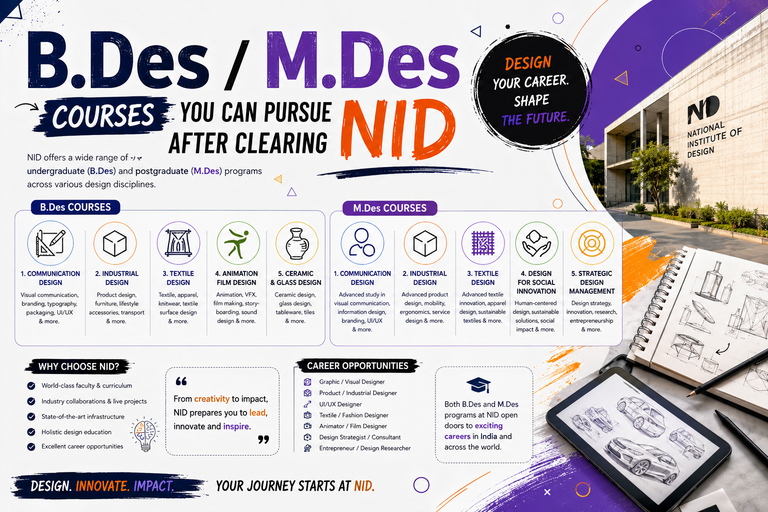
The institute’s B.Des programme is a four-year programme with disciplines across communication design, industrial design, textile/apparel/lifestyle/accessory design and ceramic & glass design. nid.edu
Because the number of seats is limited, competition for Ahmedabad can be particularly intense. A student who wants Ahmedabad should therefore aim for the highest possible final merit rank, rather than setting a target based on a historical closing rank.
Other NID Campuses
NID’s other campuses also provide design education through the NID system and can be excellent choices depending on the student’s academic interests and campus preference.
For this reason, students should not think of their NID result only as:
“Ahmedabad or no admission.”
A broader preference strategy can give a student more opportunities during seat allotment.
How Many Seats Are Available in NID B.Des?
Seat intake is one of the reasons rank matters so much in NID admissions.
For the current NID admission structure, the B.Des./Integrated pathway includes multiple institutes with different seat capacities. The published 2027-28 handbook identifies the individual NID institutes and their intake capacity; students should always use the latest official handbook because seat numbers and programme structures can be amended. DocShare
For context, the previous official B.Des handbook listed the following total intake:
| Institute | B.Des Seats in 2025-26 |
|---|---|
| NID Ahmedabad | 125 |
| NID Andhra Pradesh | 75 |
| NID Haryana | 75 |
| NID Madhya Pradesh | 75 |
| NID Assam | 75 |
| Total | 425 |
These figures are from the 2025-26 handbook and should not be treated as the 2027-28 final intake unless confirmed in the latest handbook. NID Admissions
This distinction matters because students often search for an exact “NID cutoff rank” without considering how the number of seats, category-wise reservation and campus preferences affect allotment.
Does NID Have One Common Closing Rank?
No. It is more accurate to think of NID admissions in terms of category-wise merit and campus allotment rather than one universal closing rank.
The final merit list is prepared according to the admission rules, and seat allotment considers:
- Candidate’s merit position
- Applicable category
- Campus preference submitted by the candidate
- Availability of seats
- Applicable reservation and admission rules
NID’s 2026 B.Des handbook explicitly states that campus allotment is based on campus preferences, order of merit and availability of seats in the respective category. It also states that obtaining a merit-list rank does not guarantee admission. NID Admissions
Therefore, two students with apparently similar ranks can have different outcomes depending on their category and preference choices.
Is NID Rank Different for General, OBC, SC and ST Candidates?
Yes. NID maintains category-wise admission processes and reservation rules, so a candidate’s category can affect the competition for available seats.
The B.Des admission structure includes categories such as:
The exact seat allocation and reservation structure should always be checked in the admission handbook for the relevant year. NID Admissions
This is why statements such as “NID admission is possible only up to Rank X” can be misleading unless they specify the year, programme, campus and category.
What Rank Should You Target for NID Ahmedabad?
If NID Ahmedabad is your first preference, the safest strategy is simple: target the highest possible rank rather than a minimum acceptable rank.
There is no reliable official number that students can use before the admission process to guarantee Ahmedabad.
Your final outcome can depend on:
A candidate with a strong rank should still fill campus preferences carefully because NID uses the preference order during allotment. NID Admissions
What Happens After You Get Your NID Rank?
Getting your final rank is not necessarily the last step.
For B.Des./Integrated M.Des admissions, students may need to complete the institute’s prescribed admission and seat-allotment formalities.
A simplified process is:
- DAT Prelims
- DAT Prelims result and merit-based shortlisting
- DAT Mains
- Final merit list
- Submission/confirmation of institute preferences as instructed
- Seat allotment
- Document submission and other admission formalities
- Seat confirmation within the prescribed deadline
The exact dates and procedures can change each year. For the 2027-28 cycle, NID has already published the admissions portal and handbook, while some later-stage dates are to be announced. NID Admissions
Does a Good NID Rank Guarantee Admission?
No. A good NID rank improves your chances, but it does not by itself guarantee admission to a particular campus.
NID itself states that obtaining a rank in the merit list does not guarantee admission. Seat allotment depends on factors including the candidate’s campus preferences, order of merit and availability of seats in the applicable category. NID Admissions
This is an important distinction:
Good rank → stronger position in allotment
It does not necessarily mean:
Good rank → guaranteed Ahmedabad seat
Students should therefore keep realistic alternatives in their preference list.
How Should You Fill NID Campus Preferences?
Campus preference should be based on your actual priorities rather than what other students call the “best” campus.
Before submitting preferences, consider:
Most importantly, do not place a campus above another simply because you think it will be easier to get. Your preference order can directly affect the allotment process.
NID’s official admission information makes clear that institute allotment is linked to the preference submitted by the candidate and the availability of seats. NID Admissions
Why You Should Not Depend Only on Previous Year’s Cutoff
Searching for previous NID closing ranks can be useful, but using them as fixed targets has limitations.
The closing position can change because of:
A previous year’s closing rank is therefore better treated as historical reference data, not as a guaranteed prediction for the next admission cycle.
For the same reason, websites may publish “expected NID cutoff” figures, but students should distinguish those estimates from figures officially released by NID.
What Is More Important: NID Rank or NID Score?
For admission purposes, the final merit position is highly important because seat allotment is conducted according to merit and seat availability.
However, students should not become overly focused on predicting a particular rank while preparing.
Your actual objective should be to maximize your performance across the stages of the NID DAT process.
NID describes admission to its programmes as being based on performance in the Design Aptitude Test stages. nid.edu
So instead of preparing for “Rank 200” or “Rank 500,” a stronger preparation approach is to aim for:
How to Improve Your Chances of Getting a Good NID Rank
A high NID rank comes from performing strongly throughout the admission process. Preparation should therefore go beyond simply memorising design-related facts.
1. Understand the NID DAT Format
Start by understanding what the exam is testing and how the stages of the admission process work.
Do not prepare solely from generic design entrance material. Study the actual NID requirements and official information for your admission cycle.
2. Practise Drawing and Visual Communication
Drawing is not simply about producing attractive artwork.
NID preparation should also develop your ability to communicate an idea clearly through visuals.
Practise:
3. Solve Previous Year Questions
Previous year papers can help you understand the type of thinking expected in the exam.
While solving them, do not focus only on whether an answer is correct. Analyse:
Students looking for structured resources can also explore relevant NID previous year papers alongside their regular practice.
4. Build a Regular Practice Routine
A short, consistent practice session is usually more useful than occasional long sessions.
For example, your weekly preparation can include:
| Practice Area | What to Work On |
|---|---|
| Drawing | Sketching, perspective and observation |
| Creativity | Multiple solutions to one problem |
| Visual reasoning | Patterns, compositions and visual relationships |
| General awareness | Design, culture, products and visual culture |
| Previous papers | Timed practice |
| Review | Analyse mistakes and improve responses |
5. Practise Under Time Pressure
A creative answer is not useful if you cannot complete the paper within the available time.
Regular timed practice helps you decide:
Common Mistakes Students Make While Targeting a Good NID Rank
Chasing a Fixed Cutoff
Students sometimes decide that a particular rank is “enough” and prepare only to reach it.
That is risky because the competitive landscape changes every year.
Ignoring the Mains Stage
Strong performance in one stage should not lead to complacency about the next.
NID’s admission process involves multiple stages, so preparation should account for the complete selection process rather than only the initial examination. nid.edu
Focusing Only on Drawing
NID is a design aptitude examination, not simply a drawing competition.
A candidate also needs to develop observation, creativity, problem solving and the ability to communicate ideas visually.
Copying Other Students’ Campus Preferences
Your preference order should reflect your own priorities.
Do not assume that another candidate’s preference list will be appropriate for you.
Trusting Unofficial Cutoff Numbers
Search results can contain predicted, expected or historical cutoff figures. These should not be confused with official NID admission rules.
For current admissions, the safest source is the official NID admissions portal and the applicable admissions handbook. The 2027-28 portal specifically directs applicants to the official admissions website and provides the current handbook and programme information. NID Admissions
How D’Finite Academy Can Help With NID Preparation
Students preparing for NID can benefit from a structured preparation approach that combines concept building, regular practice and exam-focused evaluation.
At D’Finite Academy, NID aspirants can use structured design entrance preparation alongside independent practice, with attention to the skills required for design aptitude examinations. Students should still use the official NID handbook as the final authority for eligibility, exam rules, dates and admission procedures.
For students preparing for several design entrance exams, preparation can also be planned around overlapping skills relevant to NID, UCEED, NIFT and other design entrance examinations, while keeping the specific requirements of each examination separate.
NID itself advises applicants to rely on its official admission information and states that it has not authorised or franchised coaching classes for conducting NID admission-test preparation. NID Admissions
NID Rank vs Campus Preference: A Simple Example
Suppose two students have similar merit positions.
Student A places only one campus as a preferred option.
Student B lists several campuses in a carefully considered preference order.
If the preferred seat is unavailable at the time of allotment, the second student’s broader preference list can provide additional possibilities, subject to the applicable admission rules.
This does not mean that students should randomly add campuses. The preference list should reflect where they are genuinely willing to study.
What Should You Do If Your NID Rank Is Not Very High?
Do not assume that a rank automatically ends your admission chances.
First, check:
- Your category
- Your campus preference
- The seats available under the applicable category
- The current allotment round
- Whether subsequent rounds are scheduled
- The official instructions for accepting, declining or participating in further allotment
NID’s seat-allotment instructions can allow movement through subsequent rounds depending on the candidate’s allotted choice and submitted preferences. The exact rules must be followed for the relevant admission year.
Frequently Asked Questions
What is a good NID rank for Ahmedabad?
A very high merit rank is generally the best position for students targeting NID Ahmedabad. However, NID does not publish one permanent “safe rank” that guarantees Ahmedabad admission. Campus allotment depends on merit, category, preferences and seat availability.
Is NID rank enough to get admission?
No. Obtaining a rank in the NID merit list does not itself guarantee admission. NID states that seat allotment depends on factors including the candidate’s campus preference, order of merit and available seats in the applicable category. NID Admissions
Which NID campus is the most competitive?
NID Ahmedabad is generally the most sought-after campus among B.Des aspirants. However, competition and allotment outcomes can vary each year, so students should not rely on an assumed fixed closing rank.
Does category affect the NID cutoff rank?
Yes. NID follows category-wise merit and reservation rules. Therefore, the rank position required for an admission outcome can differ depending on the candidate’s category and the seats available under that category. NID Admissions
Can I get NID with a lower rank?
It may still be possible to receive a seat depending on your category, campus preferences, seat availability and the movement of allotment rounds. A lower rank should not automatically be treated as a rejection before checking the official allotment information.
Should I target a specific NID rank?
Instead of preparing for a fixed cutoff, aim for the highest possible rank. Historical closing ranks can provide context, but they are not guaranteed predictors of the next admission cycle.
How many NID campuses offer B.Des?
For the 2027-28 B.Des./5.5-year Integrated M.Des admission pathway, the NID system lists Ahmedabad, Andhra Pradesh, Haryana, Madhya Pradesh and Assam among the participating institutes. NID Admissions
Where can I check the official NID 2027 admission information?
The official NID admissions portal is admissions.nid.edu. The 2027-28 portal provides the current application information, programme details, admissions handbook and updates. NID Admissions
Conclusion
A good NID rank is ultimately the rank that puts you in a strong position for your preferred campus and category, but there is no single rank that guarantees admission to every NID institute.
If NID Ahmedabad is your target, aim as high as possible rather than preparing around a predicted cutoff. Keep your campus preferences realistic, understand the category-wise admission system, and follow the latest official NID handbook for the year you are applying.
For students who prefer structured guidance, D’Finite Academy’s NID preparation support can be considered alongside regular self-study, previous-paper practice and consistent skill development.