B.Des / M.Des Courses You Can Pursue After Clearing NID
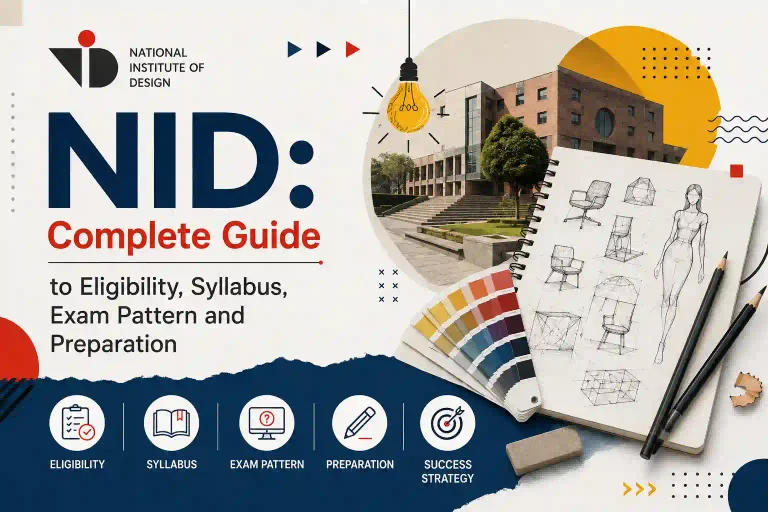
The National Institute of Design (NID) offers design education through undergraduate and postgraduate programmes across its participating campuses in India. Admission is based on the applicable Design Aptitude Test (DAT) and the selection process prescribed for each programme.
Students completing Class 12 can explore undergraduate-entry design programmes, while graduates with eligible qualifications can apply for postgraduate design programmes. The courses available, their duration and admission requirements vary by campus and academic year.
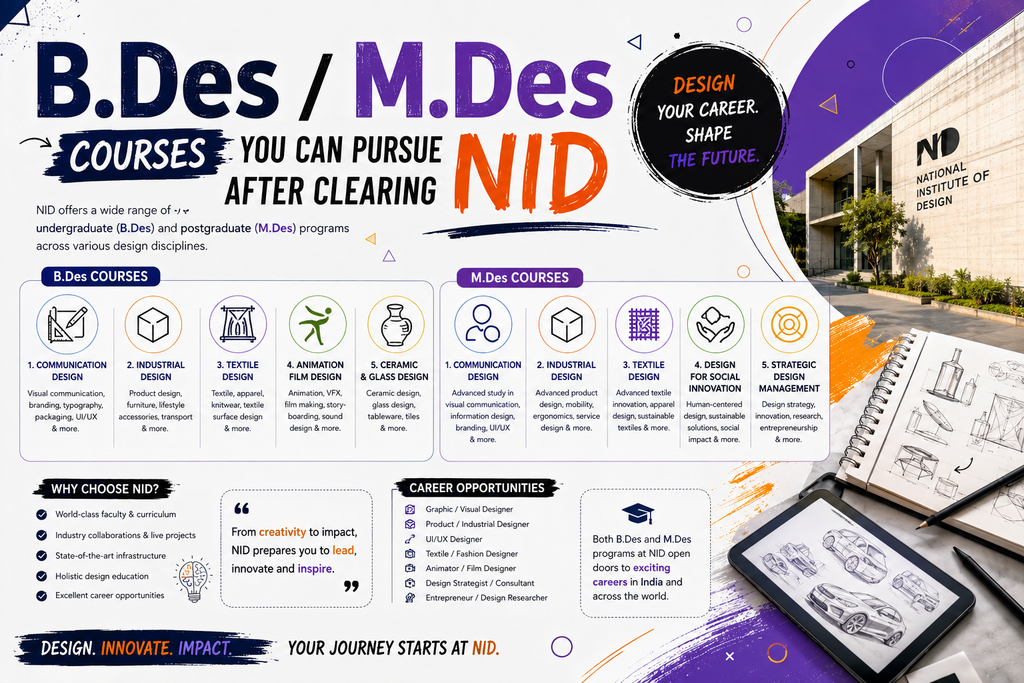
For the 2027–28 admission cycle, NID’s official admissions portal lists B.Des., M.Des. and integrated professional education pathways. This guide explains the design courses available through these routes, their specialisations, programme duration and participating institutes.
NID-DAT (National Institute of Design – Design Aptitude Test) is the entrance examination used by the National Institute of Design for admission to its design programmes. For B.Des. admission, the process consists of DAT Prelims followed by DAT Mains. The examination evaluates design aptitude, creativity, visual understanding, problem-solving and related skills.
About B.Des. and M.Des. Courses at NID
The National Institute of Design is an institution dedicated to multidisciplinary design education. Its programmes cover areas such as communication, products, textiles, digital experiences and other design disciplines.
NID’s admission process uses the Design Aptitude Test (DAT), with examination stages and selection requirements determined by the programme and campus.
The principal degree routes include:
- Bachelor of Design (B.Des.): An undergraduate design degree for eligible applicants entering through the prescribed school-level qualification route.
- Master of Design (M.Des.): A postgraduate design degree for applicants who satisfy the requirements for their chosen specialisation.
- Integrated professional education pathway: A programme structure listed for the 2027–28 admission cycle at specified campuses. Applicants should review the current handbook for the exact qualification, duration and progression arrangements.

Courses You Can Pursue Through NID Admission
The courses available depend on the institute, programme structure and admission year. B.Des. and M.Des. are not interchangeable qualifications: they have different entry requirements and academic objectives.
Bachelor of Design (B.Des.)
The Bachelor of Design is an undergraduate programme that introduces students to design principles, research, creative problem-solving and the development of design solutions.
The conventional B.Des. programme is four years long. However, applicants must check the programme structure listed for their selected campus and admission route.
Possible areas of design study across NID’s academic offerings include:
- Communication and graphic design
- Animation and film-related design
- Product and industrial design
- Textile design
- Furniture and interior-related design
- Exhibition design
- Ceramic and glass design
- Other disciplines listed in the current programme handbook
The availability of a particular specialisation must be verified for the chosen campus and academic year.
Read Also
- UCEED 2027: Eligibility, Exam Pattern, Syllabus, Preparation Strategy, Colleges & Career Guide
- NID-DAT: Complete Guide to NID Entrance Exam
- NIFT Entrance Exam: Eligibility, Exam Pattern, Syllabus
- JEE Main Paper 2 (2027): B. Arch Exam Pattern, Syllabus, Eligibility
- CEED 2027: Eligibility, Exam Pattern, Syllabus, Preparation & Coaching Guide
Master of Design (M.Des.)
The Master of Design is a postgraduate programme intended for eligible applicants seeking advanced study in a specific design discipline.
The conventional M.Des. programme at NID Ahmedabad, Gandhinagar and Bengaluru is generally two and a half years long. Programme duration and structure may differ for other admission routes.
Depending on the campus and current offering, areas of specialisation may include:
- Communication Design
- Industrial Design
- Textile Design
- Interaction Design
- Information Design
- Digital Game Design
- Strategic Design Management
- Apparel and Lifestyle Accessory Design
- Design for Retail Experience
These are examples of design disciplines associated with NID’s academic offerings, not a guarantee that every specialisation is available at every campus in 2027–28. Refer to the relevant M.Des. handbook for the confirmed list.
Integrated Professional Education Pathway
NID’s 2027–28 admissions information lists a 5.5-year Professional Education Master of Design (Integrated Pathway) at Ahmedabad, Gandhinagar and Bengaluru.
The admission portal also lists integrated M.Des./B.Des. programme options associated with NID Madhya Pradesh, NID Haryana, NID Andhra Pradesh and NID Assam.
These programme structures should be reviewed separately because their qualifications, durations, eligibility criteria and admission arrangements may differ.
Applicants should confirm the exact course title and degree awarded from the relevant official handbook before applying.
B.Des. vs M.Des. at NID
| Particular | B.Des. | M.Des. |
|---|---|---|
| Degree level | Undergraduate | Postgraduate |
| Typical entry qualification | Class 12 or an accepted equivalent, subject to the applicable rules | An eligible bachelor’s degree or other accepted qualification |
| Conventional duration | 4 years | 2.5 years |
| Admission route | Applicable undergraduate DAT process | Applicable postgraduate DAT process |
| Main academic focus | Foundation and professional design education | Advanced or specialised design education |
| Specialisations | Depend on the programme and campus | Depend on the programme and campus |
The table describes conventional degree routes. Integrated programmes and other campus-specific structures may have different durations and requirements.
NID Campuses and Course Availability
NID has campuses across India. The courses and qualifications available through the admission process depend on the campus and the relevant admission year.
| Institute | Location | Programme information |
|---|---|---|
| National Institute of Design, Ahmedabad | Ahmedabad, Gujarat | B.Des. and specified postgraduate/integrated routes |
| National Institute of Design, Gandhinagar | Gandhinagar, Gujarat | Specified M.Des. and integrated pathways |
| National Institute of Design, Bengaluru | Bengaluru, Karnataka | Specified M.Des. and integrated pathways |
| National Institute of Design, Andhra Pradesh | Andhra Pradesh | Integrated B.Des./M.Des. programme structure listed for 2027–28 |
| National Institute of Design, Haryana | Haryana | Integrated and postgraduate options as listed in the current handbook |
| National Institute of Design, Madhya Pradesh | Madhya Pradesh | Integrated and postgraduate options as listed in the current handbook |
| National Institute of Design, Assam | Assam | Integrated programme structure listed for 2027–28 |
Important: The 2027–28 admissions portal includes programme-specific information and amendments. Check the latest handbook before treating any course, campus or specialisation as confirmed.
Eligibility for NID Design Courses
Eligibility depends on the programme and admission route.
Undergraduate and Integrated-Entry Programmes
Applicants should check whether they meet the prescribed school-level qualification requirements, age conditions and other criteria specified in the relevant handbook.
The requirements for B.Des. and an integrated professional education pathway may differ, so applicants should confirm which route they are applying for.
Postgraduate M.Des. Programmes
M.Des. applicants must meet the accepted degree or qualification requirements for their selected programme. The eligible disciplines, degree duration and other conditions may vary by specialisation and campus.
Candidates should consult the relevant 2027–28 admissions handbook for the complete eligibility rules.
NID Admission Process
Admission is based on the selection procedure applicable to the selected programme.
The general application process involves:
- Visiting the official NID admissions portal.
- Registering for the relevant admission cycle.
- Selecting the appropriate programme or admission route.
- Completing the application form.
- Uploading the required documents.
- Paying the prescribed application fee.
- Appearing for the applicable examination and selection stages.
- Checking the result and completing subsequent admission formalities.
The exact examination stages, selection criteria and admission requirements should be confirmed from the official handbook.
NID Admission 2027–28: Important Information
The official NID admissions portal provides the current admission handbooks, programme details, fee information and application links for the 2027–28 cycle.
The portal lists 30 November 2026 as the application deadline for the specified B.Des./integrated and M.Des. admission routes. Candidates must check the individual programme instructions for the applicable deadline and any subsequent amendments.
Frequently Asked Questions
Conclusion
NID offers several routes into professional design education, including undergraduate B.Des., postgraduate M.Des. and specified integrated pathways. Each route has its own eligibility requirements, programme duration and campus options.
Students should compare the available programmes and consult the current admission handbook before selecting a course. Confirming the degree structure and specialisation at the intended campus is particularly important for the 2027–28 admission cycle.
D’Finite Academy provides educational information and resources for students exploring design and architecture entrance examinations, including NID, NIFT, UCEED, CEED and NATA.