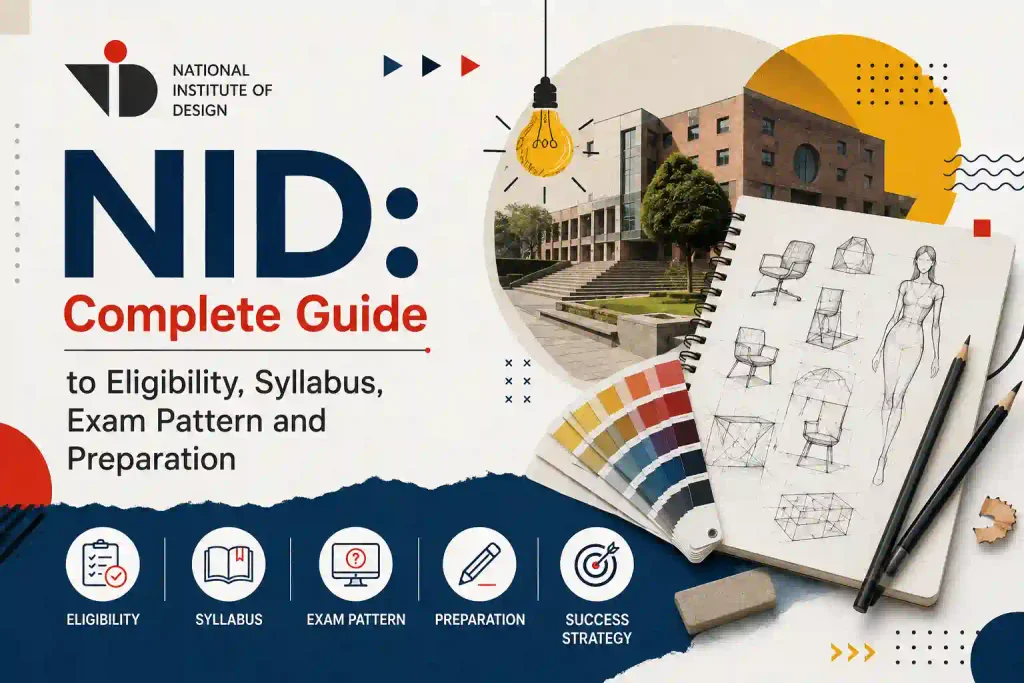
NID: Complete Guide to Eligibility, Syllabus, Exam Pattern and Preparation
The National Institute of Design (NID) conducts the Design Aptitude Test (DAT) for admission to its design programmes. Students seeking admission to undergraduate Bachelor of Design (B.Des) programmes generally apply through NID DAT Prelims and, if shortlisted, NID DAT Mains. The examination assesses design aptitude, observation, creativity, visualisation, analytical thinking and the ability to communicate ideas.
To prepare for NID, students need to understand the eligibility criteria, syllabus, examination pattern, admission process and skills assessed at each stage. Regular drawing practice, creative problem-solving, previous year question papers, mock tests and awareness of design in everyday life can help build a strong foundation.
This guide by D’Finite Academy explains the key aspects of NID admission, including the difference between the Prelims and Mains examinations, important syllabus areas, preparation strategies and common mistakes to avoid.
NID-DAT (National Institute of Design – Design Aptitude Test) is the entrance examination used by the National Institute of Design for admission to its design programmes. For B.Des. admission, the process consists of DAT Prelims followed by DAT Mains. The examination evaluates design aptitude, creativity, visual understanding, problem-solving and related skills.
What Is NID DAT?
NID DAT stands for the National Institute of Design Design Aptitude Test. It is the entrance examination used for admission to eligible design programmes offered by the National Institute of Design system.
NID is known for design education across disciplines that may include product design, communication design, textile and apparel-related design, animation and film-related disciplines, depending on the institute and programme structure.
The admission process for undergraduate and postgraduate programmes is not identical. Students seeking a B.Des generally follow the undergraduate admission process, while applicants to Master of Design (M.Des) programmes must follow the separate postgraduate requirements.
NID DAT is designed to assess more than drawing skill. Candidates may need to interpret visual information, identify problems, develop original ideas, respond to practical situations and communicate their thinking clearly.
Students interested in the following areas may consider exploring NID programmes:
- Product and industrial design
- Communication and graphic design
- Animation and film-related design
- Textile and apparel-related design
- Exhibition and spatial design
- Other specialisations offered by participating NID campuses
The exact programmes and disciplines available vary by institute and admission year. Candidates should consult the official NID admissions website before choosing their preferences.
Read Also
- UCEED 2027: Eligibility, Exam Pattern, Syllabus, Preparation Strategy, Colleges & Career Guide
- NID-DAT: Complete Guide to NID Entrance Exam
- NIFT Entrance Exam: Eligibility, Exam Pattern, Syllabus
- JEE Main Paper 2 (2027): B. Arch Exam Pattern, Syllabus, Eligibility
- CEED 2027: Eligibility, Exam Pattern, Syllabus, Preparation & Coaching Guide
NID Eligibility Criteria
NID eligibility depends on the programme, qualifying examination, age requirements and admission year. Undergraduate applicants must meet the prescribed Class 12 or equivalent qualification requirements, while postgraduate applicants must satisfy the relevant degree requirements.
Candidates should verify the official admission handbook for their examination cycle because age limits, accepted qualifications and passing-year conditions can change.
1. Educational Qualification for B.Des
Students who have passed or are appearing for Class 12 or an equivalent qualifying examination may be eligible to apply for the B.Des admission process, subject to the current NID rules.
Applicants from Science, Commerce, Arts and Humanities backgrounds can generally apply if they satisfy the prescribed conditions. A previous qualification in fine arts or design is not necessarily required.
Accepted boards, qualifying examination years and any additional conditions should be checked in the official admission handbook.
2. Age Limit for B.Des
NID prescribes age-related eligibility requirements for undergraduate applicants. The permitted date of birth may differ by category, where applicable.
Candidates should check the specific age cut-off published for the relevant admission year rather than relying on a date mentioned in an older article or coaching resource.
3. Eligibility for M.Des
Applicants to postgraduate design programmes generally need a recognised bachelor’s degree or another qualification accepted under the applicable NID rules.
The accepted degree types, duration requirements, discipline conditions and age criteria may differ from those for B.Des. Candidates should read the postgraduate admission handbook separately before applying.
4. Can Students From Any Stream Apply for NID?
Yes, students from different academic streams can generally apply for undergraduate design programmes if they meet the official eligibility requirements.
NID preparation emphasises design aptitude, observation, creativity, problem-solving and visual communication. Students do not need to assume that only those with an artistic background can prepare for the examination.
Candidates from every stream should assess their current drawing, reasoning and creative problem-solving skills and build a preparation plan around their individual needs.

NID Eligibility at a Glance
| Eligibility factor | B.Des applicants | M.Des applicants |
|---|---|---|
| Basic qualification | Class 12 or an accepted equivalent | Bachelor’s degree or another accepted qualification |
| Academic background | Different streams may be eligible | Depends on the prescribed degree requirements |
| Age criteria | As specified in the undergraduate handbook | As specified in the postgraduate handbook |
| Admission examination | Undergraduate NID DAT process | Postgraduate NID DAT process |
| Additional requirements | Must satisfy current admission rules | Must satisfy current programme-specific rules |
Meeting the eligibility criteria does not guarantee admission. Candidates must complete the selection process, meet the applicable requirements and secure a place according to the prescribed admission rules.
NID DAT Exam Pattern
The NID Design Aptitude Test generally follows a two-stage selection process: DAT Prelims and DAT Mains. Candidates are shortlisted for the subsequent stage according to the rules published for their admission cycle. The format, question types, marks, weightage and nature of DAT Mains can differ by programme and year, so applicants must consult the applicable official admission handbook.
NID DAT Prelims
DAT Prelims is the initial examination stage. It assesses design aptitude through questions that may test visual understanding, analytical reasoning, creativity, observation and problem-solving.
Depending on the examination cycle and programme, candidates may encounter objective and subjective questions. Preparation should therefore cover both the ability to select or identify an answer and the ability to explain or communicate an idea.
Important skills include:
- Visual perception and observation
- Logical and analytical reasoning
- Creative thinking
- General design awareness
- Interpretation of images and visual information
- Problem-solving and originality
- Written communication where required
Candidates should check the latest handbook for the confirmed examination mode, duration, marking scheme, question formats and any changes to the selection process.
NID DAT Mains
DAT Mains is the subsequent selection stage for shortlisted candidates. Its format depends on the applicable programme and admission cycle.
Historically, NID has used practical or studio-based assessments to examine how candidates respond to design tasks. Such assessments can require students to develop ideas, work with materials, interpret a brief or communicate a concept under time constraints.
The skills worth developing include:
- Translating a problem into a visual concept
- Exploring alternative solutions
- Working with form, structure and materials
- Communicating ideas clearly
- Applying creativity to practical constraints
- Responding thoughtfully to a design brief
Do not assume that every NID programme follows an identical Mains format. Check the programme-specific instructions before beginning final-stage preparation.
NID DAT Prelims vs DAT Mains
| Feature | DAT Prelims | DAT Mains |
|---|---|---|
| Role | Initial selection stage | Subsequent selection stage |
| Main purpose | Assess design aptitude and related skills | Assess skills through the prescribed next-stage evaluation |
| Preparation focus | Reasoning, observation, creativity and visual understanding | Practical problem-solving and programme-specific assessment skills |
| Who participates? | Eligible applicants who complete the application process | Candidates shortlisted according to official rules |
| Format | As specified in the current handbook | As specified in the current handbook |
NID Syllabus
The NID syllabus should be understood as a collection of design-related abilities rather than a conventional school-subject syllabus. Candidates need to develop observation, visual reasoning, creativity, communication and practical problem-solving skills.
The exact syllabus and question format should be checked in the official admission handbook for the relevant programme and year.
1. Creativity and Original Thinking
Creativity is the ability to develop ideas that are relevant, meaningful and different from obvious solutions.
Practise:
- Generating multiple solutions to a single problem
- Reimagining everyday objects
- Visual and verbal associations
- Creating stories from images
- Developing alternative uses for familiar objects
- Communicating ideas through sketches
- Solving problems within practical constraints
For example, consider how a reusable lunch container could be redesigned for a student who travels by public transport. You might explore compact storage, spill prevention, ease of cleaning and the use of sustainable materials.
2. Drawing and Visual Communication
Drawing helps candidates communicate ideas that may be difficult to explain using words alone.
Important areas include:
- Basic shapes and three-dimensional forms
- Perspective and depth
- Proportion and scale
- Composition
- Line quality and clarity
- Light, shade and texture
- Human figures and everyday activities
- Object drawing from observation
- Visual storytelling
A clear drawing should communicate the intended idea. Students should first learn to represent forms accurately and arrange elements logically before concentrating on decorative details.
3. Observation and Visual Sensitivity
Observation involves noticing details, relationships and differences that others may overlook.
Useful exercises include:
- Comparing two similar objects
- Identifying visual inconsistencies
- Studying shapes, textures and patterns
- Observing human behaviour in public spaces
- Analysing signs, packaging and everyday products
- Understanding how colours and layouts affect communication
Try sketching an everyday object from memory and then comparing it with the actual object. This exercise can reveal which details you tend to overlook.
4. Logical and Analytical Reasoning
Design problems often require candidates to understand information, recognise patterns and make decisions based on evidence.
Practise:
- Shape and number sequences
- Classification and grouping
- Visual puzzles
- Spatial reasoning
- Pattern completion
- Relationships between objects
- Logical deductions
- Interpreting written or visual instructions
Reasoning exercises can also help candidates become more systematic when approaching unfamiliar creative tasks.
5. Visualisation and Spatial Understanding
Spatial understanding is the ability to imagine how objects look from different directions and how their forms relate to one another.
Important topics include:
- Two-dimensional and three-dimensional shapes
- Rotations and reflections
- Mental manipulation of objects
- Understanding perspective
- Identifying different views of an object
- Spatial relationships
- Form and structure
Simple exercises involving boxes, paper folding, household objects and geometric shapes can help develop this skill.
6. Design Awareness and General Awareness
Candidates should understand how design relates to culture, society, technology and the environment.
Useful areas to explore include:
- Indian crafts and traditional visual forms
- Contemporary product design
- Graphic communication and typography
- Sustainable design practices
- Accessibility and inclusive design
- Public spaces and everyday infrastructure
- Material properties and product functions
- The relationship between design and human behaviour
The objective is to develop an informed way of observing the world, not simply memorise lists of designers or products.
7. Problem-Solving and Design Thinking
Design thinking involves identifying a problem, understanding the user and developing a practical solution.
A useful framework is:
- Understand the situation and identify the problem.
- Identify the needs of the intended user.
- List the constraints, such as cost, safety, space or materials.
- Generate several possible solutions.
- Select a suitable concept.
- Communicate the solution through sketches or other methods required by the task.
For instance, if asked to improve a school bag for younger students, consider weight distribution, comfort, storage, durability and ease of use rather than focusing only on appearance.
8. Language and Communication
Candidates may need to understand written instructions, interpret a design brief and communicate their thinking effectively.
Preparation can include:
- Reading comprehension
- Understanding written requirements
- Organising ideas logically
- Explaining a concept clearly
- Using concise descriptions
- Interpreting information in context
Reading design articles, product descriptions and explanatory writing can help students become more comfortable with unfamiliar topics.
How to Prepare for NID DAT
A good preparation plan combines daily skill development with regular assessment. Students should identify their weak areas early and allocate time to drawing, reasoning, observation and creative problem-solving instead of relying on one type of practice.
Step 1: Read the Official Admission Handbook
Start with the handbook for the exact programme you intend to apply for. Understand the eligibility conditions, selection stages, syllabus, examination format and application requirements.
This is particularly important because B.Des and M.Des admissions have different requirements.
Step 2: Assess Your Current Skills
Attempt a selection of practice questions and complete a few basic drawing exercises.
Record your current difficulties. You may need to improve perspective, generate ideas more quickly, solve visual puzzles or understand design briefs. This assessment gives you a practical starting point.
Step 3: Practise Drawing Consistently
Spend time drawing objects from observation rather than copying finished illustrations alone.
Begin with everyday objects, then progress to scenes involving people, furniture and surroundings. Practise perspective, proportion, composition and the clear communication of actions.
Review each drawing and identify one or two areas to improve in your next attempt.
Step 4: Develop a Design Observation Journal
Maintain a notebook for design ideas and everyday observations.
You can include:
- Sketches of common objects
- Interesting packaging and signs
- Examples of accessible or sustainable design
- Problems noticed in public spaces
- Alternative concepts for existing products
- Notes on why particular designs work well
This journal provides a useful record of your thinking and encourages you to look at familiar objects from different perspectives.
Step 5: Solve Previous Year Papers
Previous year papers help candidates understand the style of questions and identify areas that require more attention.
Use official sample papers and other resources published through the NID admissions website. Review the available answer keys or explanations where provided.
Follow this method:
- Attempt a paper or practice set.
- Review every incorrect or uncertain answer.
- Identify the reason for the mistake.
- Practise similar questions.
- Revisit the topic after a few days.
Avoid treating previous year papers as a guarantee of what will appear in the next examination. Use them to develop skills and understand question formats.
Step 6: Practise Under Time Constraints
Timed practice helps you learn how to allocate attention across different tasks.
Start with individual exercises and introduce time limits once you understand the underlying concepts. As the examination approaches, practise complete papers or simulations that reflect the latest official pattern.
After each attempt, evaluate accuracy, clarity and time management rather than focusing only on the total score.
Step 7: Review Your Progress Weekly
At the end of each week, assess your performance across the major preparation areas.
Ask yourself:
- Which question types took the longest?
- Which mistakes occurred repeatedly?
- Are your drawings becoming clearer?
- Can you generate multiple ideas for one problem?
- Are you able to communicate your solutions effectively?
- Which topics require further revision?
Use these observations to plan the next week’s study sessions.
NID Preparation Plan: A 12-Week Schedule
The following schedule is a suggested framework for organising preparation. It is not an official NID timetable and should be adapted to your current skills and the examination date.
| Phase | Weeks | Preparation focus |
|---|---|---|
| Foundation | 1–3 | Understand the syllabus, practise basic reasoning and assess drawing skills |
| Skill development | 4–6 | Improve observation, perspective, creativity and visual reasoning |
| Application | 7–9 | Solve previous year papers and practise design problems |
| Assessment | 10–11 | Complete timed practice and review recurring mistakes |
| Final revision | 12 | Revisit weak areas and prepare according to the confirmed examination format |
Suggested Daily Study Routine
| Activity | Suggested time |
|---|---|
| Drawing and visual communication | 45 minutes |
| Logical and visual reasoning | 45 minutes |
| Design observation and awareness | 30 minutes |
| Creative problem-solving | 45 minutes |
| Revision and error analysis | 15 minutes |
| Total | 3 hours |
Students with school or college commitments can divide these activities across the week. Consistency and careful review are more useful than following a timetable that cannot be maintained.
Recommended Books and Resources for NID Preparation
Candidates can use a combination of official resources, reasoning exercises, drawing materials and independent observation activities.
| Resource | Purpose |
|---|---|
| Official NID admission handbook | Eligibility, selection process and examination requirements |
| Official sample papers | Familiarity with the prescribed question format |
| Previous year question papers | Practice and performance analysis |
| Drawing paper and pencils | Observational drawing and visual communication |
| Spatial reasoning exercises | Understanding shapes and three-dimensional forms |
| Design journals and product case studies | Developing design awareness |
| Reading materials | Improving comprehension and written communication |
No single book should be treated as a complete substitute for the official syllabus. Choose supplementary resources based on the specific skills you need to improve.
Common Mistakes to Avoid in NID Preparation
Focusing Only on Drawing
Drawing matters, but NID evaluates a wider range of abilities. Neglecting reasoning, observation and creative problem-solving can leave important preparation gaps.
Memorising Answers Instead of Understanding Problems
Design questions often require candidates to apply their thinking to unfamiliar situations. Learn the principle behind a solution rather than memorising an answer to one particular question.
Copying Designs Without Developing Original Ideas
Reference images can help you understand perspective and form, but independent problem-solving requires you to generate your own concepts. Practise developing multiple solutions before selecting one.
Ignoring the Official Admission Handbook
Older preparation articles may describe examination patterns, eligibility rules or selection procedures that no longer apply. Always use the handbook for your admission year.
Spending Too Much Time on One Skill
A student who spends every preparation session drawing may neglect reasoning or other assessed abilities. Maintain a balanced schedule and revise it according to your performance.
Practising Without Reviewing Mistakes
Completing many questions does not automatically lead to improvement. Review errors, identify the cause and repeat similar exercises until you understand the underlying concept.
How D’Finite Academy Fits Into NID Preparation
Students preparing for design entrance examinations can benefit from organised study, consistent practice and a clear understanding of the skills required by each examination.
D’Finite Academy operates in the design and architecture entrance preparation space. Students researching preparation options can explore the academy’s relevant offerings alongside official NID resources and independent practice.
When evaluating a preparation programme, look for alignment with the current syllabus, opportunities to practise relevant question formats, feedback on drawing and creative work, and a structured approach to identifying weaknesses.
NID also states on its official admissions website that it does not encourage candidates to attend coaching classes and has not authorised or franchised any organisation to conduct such classes. Candidates should therefore distinguish independent preparation services from official NID programmes or endorsements.
Students preparing for multiple design examinations can also explore relevant D’Finite Academy pages for UCEED Coaching, NIFT Coaching and Design Entrance Coaching. Those considering architecture should separately research NATA Coaching and JEE Main Paper 2 Coaching, as architecture entrance examinations assess different requirements from NID DAT.
Frequently Asked Questions
Conclusion
Preparing for NID requires a combination of observation, creativity, drawing, visual reasoning and practical problem-solving. Students should understand the official eligibility criteria, practise previous year papers, build a design observation habit and regularly review their performance.
The most useful preparation plan is one that addresses individual weaknesses while covering all relevant examination stages. Students who prefer additional structure can explore D’Finite Academy’s relevant preparation offerings alongside official NID resources and consistent self-study.